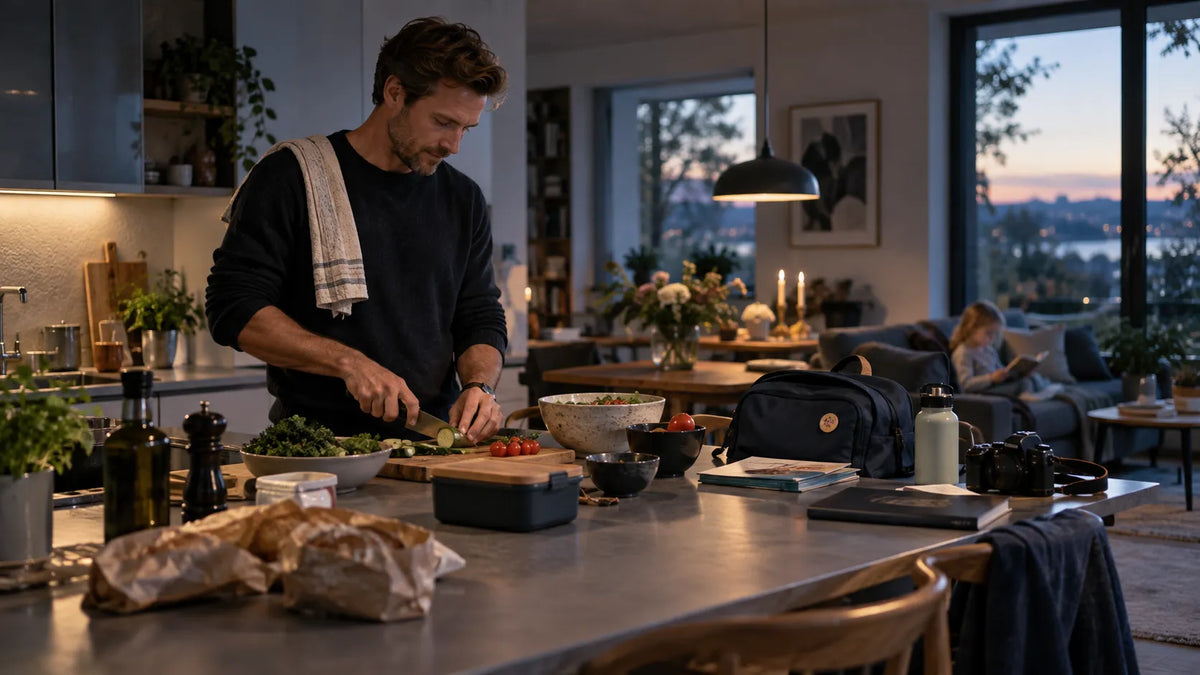

You want to start playing football again. Tuesday evenings. Nothing extreme. A couple of hours doing something you used to love. Then you look at Tuesday. Dinner. Two tired children. Bath. Bedtime. Things still need preparing for tomorrow. Your partner has had a full day too. Suddenly I want to play football again is no longer a simple decision about football. If you go, someone else absorbs what you are not doing.
So you postpone it. Next week becomes next month. Eventually the easiest conclusion is that this is simply what being a father means. Or perhaps you go the other way. You decide you need this time, that self-care matters and that being a better father requires looking after yourself. That can contain truth too. But it can still leave somebody else holding Tuesday evening.
Making room for yourself is not the same as taking room away from your family. But sometimes the same hour genuinely cannot belong to everyone.
The useful question is therefore not whether fathers deserve personal time. It is how personal room fits inside a life where your choices now affect other people.
Wanting something for yourself is not automatically selfish
Fatherhood introduces a strange moral weight to ordinary preferences. Before children, wanting to spend Saturday cycling might have required little explanation. Now it can affect childcare, couple time, household tasks, recovery and what somebody else gets to do with their Saturday. That makes the decision relational. It does not automatically make the desire selfish.
Something can matter to you personally without needing to be justified as good for everyone else.
You do not necessarily need to prove that running makes you a better father, reading makes you more patient or seeing friends improves your mental health. Sometimes you want to run because you like running. That is allowed to matter. The next question is what making room for it asks from the life around you.
Personal time has a cost — but so does having none
Suppose you spend three hours cycling on Sunday. The visible cost is relatively easy to see. You are unavailable for those three hours, so someone else may carry more of what happens at home. Now suppose you stop cycling entirely. The cost is harder to see. Perhaps nothing happens. Perhaps cycling did not matter that much after all. But perhaps one of the few places where you experienced challenge, friendship and something that was simply yours disappears from the week.
The absence of personal space can have consequences too, even when those consequences are harder to put on a calendar.
That does not mean your family owes you three hours of cycling. It means both sides belong in the picture. A trade-off becomes easier to understand when we stop pretending only one side has a cost.
The same hour can matter to two people
This becomes especially clear between partners. You want Saturday morning to train. Your partner wants Saturday morning because it is the first chance all week to be alone. Neither request is unreasonable. There is no productivity hack that creates a second Saturday morning. Sometimes family life contains genuine competing needs.
Fairness is not always finding an arrangement where nobody gives anything up. Sometimes it is making the trade-off visible enough to decide together.
That may involve alternating. Changing timing. Making one person's need more important temporarily. Finding another form. Or accepting that something cannot fit right now. The answer depends on the life. BRTLS should not decide it from outside.
“I need this” does not end the conversation
Personal-development language can make preferences sound non-negotiable.
I need my gym time.
I need time with the boys.
I need my space.
Sometimes need accurately describes something important. But the word can also close the conversation before the impact has been considered.
Having a need does not automatically decide how, when or at whose expense it should be met.
Maybe physical activity genuinely matters enormously to you. That still leaves multiple possibilities for how it enters the week. Five evening sessions are not the same request as two early mornings. A weekend away is not the same as dinner with a friend. Three uninterrupted hours are not the same as forty minutes. Understanding what matters underneath the preferred arrangement creates more room to adapt without pretending the underlying need does not matter.
“Family comes first” does not end the conversation either
The opposite phrase can close reflection just as quickly. Of course your children sometimes need to come first. A sick child does not care that tonight was your gym night. A partner who is overwhelmed may genuinely need you home. Some responsibilities are not negotiable. But family comes first can become a permanent rule under which anything personally important is automatically placed second.
A family can matter most without every family demand automatically mattering more than every personal one.
The distinction is important. Putting your child to bed may matter more tonight than your run. That does not prove your running never deserves room. Family commitment is expressed across a life, not by winning every individual scheduling conflict.
Start with what you are actually trying to make room for
Sometimes the solution becomes difficult because the request is too specific.
You say:
I need Thursday evening for football.
But what actually matters? Football itself? Seeing those friends? Competition? Physical intensity? Being somewhere nobody calls you Dad? Having one predictable commitment that belongs to you? If football itself matters, that is useful to know. If the deeper value is friendship or challenge, other forms may fit too.
The more clearly you understand what matters, the less one particular arrangement has to carry the entire need.
This is not a trick for shrinking everything important until it becomes convenient. Sometimes the specific activity really is the thing. Clarity simply helps distinguish what is essential from what is preferred.
Personal room does not always mean physical distance
There is an easy assumption that time for myself means leaving. Sometimes it does. Solitude can matter. Friendships need actual participation. A sport may happen elsewhere. Some activities need uninterrupted space. But personal expression can also happen inside family life. You can cook because you enjoy cooking rather than because dinner needs producing. Read while your children play. Work on something in the garage while family life continues nearby. Invite friends into your home rather than maintaining a completely separate social world.
Having something of your own does not always require having a life apart.
That distinction matters because the choice is not simply: family togetherness versus personal freedom. There are many arrangements between them.
But integration should not become another way of saying you never get to leave
There is a trap on the other side too.
Can you just do it with the children?
Sometimes yes. Sometimes absolutely not. Running with a buggy is not the same experience as running alone. Seeing friends with four children present is not the same social space as seeing them without children. Reading beside a toddler is not uninterrupted reading.
An adapted version can preserve something important without being equivalent to the thing it replaced.
BRTLS should not romanticise integration to the point where fathers are expected to satisfy every personal need while remaining continuously available. Sometimes being unavailable for a while is exactly what the activity requires. The question remains how that unavailability fits the shared life.
Reciprocity matters, but it does not have to become scorekeeping
A simple answer is:
You get Tuesday.
Your partner gets Thursday. Sometimes that works beautifully. But life does not always divide cleanly. One person may need more recovery during a difficult period. One activity may happen weekly while another matters once every few months. Work schedules may create unequal flexibility. One partner may genuinely want much less independent time. So reciprocity does not necessarily mean identical hours.
Fairness can include difference when the difference is visible, discussable and workable for the people carrying it.
If every hour becomes a ledger, the relationship can become exhausting. If nobody can talk about who gets room, resentment can grow quietly. The aim is neither perfect equality nor invisible sacrifice.
Some seasons leave very little room
There are stages where the available answer may simply be: not much right now. A newborn. Illness. Intensive caring. Financial pressure. A major family transition. There is no reason to pretend that every father can preserve the same personal life through every stage.
Agency within constraints sometimes means choosing from a small set of imperfect possibilities.
Perhaps football stops for three months. Perhaps your partner's need receives more room for a while. Perhaps yours does. The important part is not forcing balance into a season that cannot provide it. It is noticing when a temporary arrangement quietly becomes permanent long after the conditions changed.
Personal space works better when it is designed into life than rescued from it
When personal time exists only if everything else is finished, it has a structural problem. Everything else is rarely finished. There is always another household task. Another email. Something for school. Something that could be tidier. Something productive you could do.
If personal life only receives leftover time, responsibility gets first refusal on almost everything.
That does not mean putting your hobbies into the calendar makes them sacred. It means some things may need intentional room if they are going to exist at all. That room can still be flexible. Life answers back. Children get sick. Partners need support. Plans change. Discipline in BRTLS means reliable action while adapting — not rigidly defending a schedule against the people around you.
The goal is not independence from your family
This is the deeper distinction. You do not need to prove that you are still your own person by maximising how much of life remains separate. Nor do you prove commitment by minimising yourself.
A personal life and a family life do not have to become opposing projects.
Your interests can influence family life. Fatherhood can change your interests. Your partner's needs can affect your choices. Your own needs can deserve consideration. Sometimes you choose yourself. Sometimes someone else. Sometimes you find a version where the distinction barely matters. The measure is not independence. It is fit.
TRY THIS
Make one personal request more honest
Choose one thing you want more room for. Do not start by deciding whether you are entitled to it.
1. Name what you want in concrete terms. Instead of more time for myself, identify the actual activity, relationship or kind of space you want.
2. Ask what matters about it. Separate the specific arrangement from the value underneath it, while allowing that the activity itself may genuinely matter.
3. Make the cost visible. If you take this time, what happens elsewhere? Who becomes responsible for something you would otherwise carry?
4. Look at the cost of not making room too. Would very little change, or has something personally important already been disappearing?
5. Explore the smallest arrangement that still feels meaningful. Consider timing, frequency, duration, reciprocity and alternative forms rather than automatically restoring the old version.
6. Treat it as an experiment rather than a permanent right. Try the arrangement, notice what happens for you and the people around you, and adjust if real life answers differently than expected.
The question is not only “Can I have this?” It is “Can this become part of our life in a way we can actually carry?”
When the situation is different
Personal space is not primarily a scheduling problem when one partner is frightened to ask for time, is punished for having independent relationships, has movement or money controlled, or experiences threats, intimidation, coercion or violence. Those situations require a safety-focused response rather than ordinary negotiation advice.
The issue may also be structural rather than interpersonal. Two exhausted parents with inadequate childcare, difficult work schedules or intensive caring responsibilities cannot negotiate resources into existence. Sometimes there genuinely is too little time or capacity, and acknowledging that reality is more useful than prescribing better boundaries.
Finally, personal room is not automatically something you need more of. Some fathers genuinely prefer spending most discretionary time with family. If that fits the person and the relationships involved, there is no BRTLS standard requiring more independence.
THE WIDER BRTLS PICTURE
The desire for more personal room appears in Self. But what determines whether it fits may sit elsewhere.
Partner matters because time and responsibility are often shared. Children matter because their needs change what is realistically negotiable. Home contains work that does not disappear when you leave. Health & Vitality affects whether what you need is challenge, recovery, movement or simply less demand. Work may already consume much of the time over which you have personal control. Community may reveal that what you call time for myself is actually a wish for friendship or belonging.
That is why BRTLS does not reduce this to:
Prioritise yourself.
The more useful question is:
How do I make room for something that matters to me while staying honest about who carries the cost?
Sometimes the answer will be straightforward. Sometimes it will involve a real trade-off. Sometimes the current answer will be not now. What matters is seeing the whole picture before turning either self-sacrifice or self-prioritisation into a rule.
RELATED READING
I Don't Feel Like Myself Since Becoming a Dad
When the lack of personal room has begun changing how you experience yourself.
Why Do I Feel Like I've Lost Myself Since Having Children?
When familiar parts of you no longer have many places to appear.
Why Do I Miss My Old Life Even Though I Love Being a Dad?
When what you want room for seems connected to something life before children made easier.
Why Does Everything Feel Like It's About Work or Family Now?
When almost the entire week seems organised around responsibility.
Why Is It So Hard to Make Room for My Own Needs as a Father?
When the difficulty begins before scheduling because your own needs are hard to recognise or legitimise.
Why Do I Feel Guilty Doing Something for Myself?
When the room exists but taking it still feels wrong.
YOU ARE PART OF THE FAMILY LIFE YOU ARE PROTECTING
It is easy to picture the family on one side and yourself on the other. Every hour you take appears to move from their column into yours. Real family life is more interconnected than that. Sometimes something personally important gives you energy, friendship, enjoyment or a part of yourself that you value bringing back into family life. Sometimes it simply gives you something you enjoy. That is enough for it to matter. But there will also be moments when your choice genuinely asks more from someone else. We should not hide that behind self-care.
Your needs matter inside the family picture. They do not exist outside it.
That gives us a different alternative to both extremes. You do not need to disappear into responsibility. You do not need to defend personal freedom as though fatherhood were an intrusion on your real life. You can ask what matters to you, what it costs, what constraints are real, who else is affected and what version could actually fit.
Because you are not negotiating between your life and family life. This is your life too.
Having a life of your own inside family life is different from building a life away from your family.
And perhaps that is the better goal. Not maximum independence. Not permanent self-sacrifice. A life in which the people you love are deeply present — and you have not become invisible inside it. Your free Fatherhood Discovery helps you step back and look across Self, Partner, Children, Health & Vitality, Work, Home and Community, so you can understand what is currently asking for room before deciding what might realistically fit.
Start Your Free Fatherhood Discovery
Free · Personalised results included