
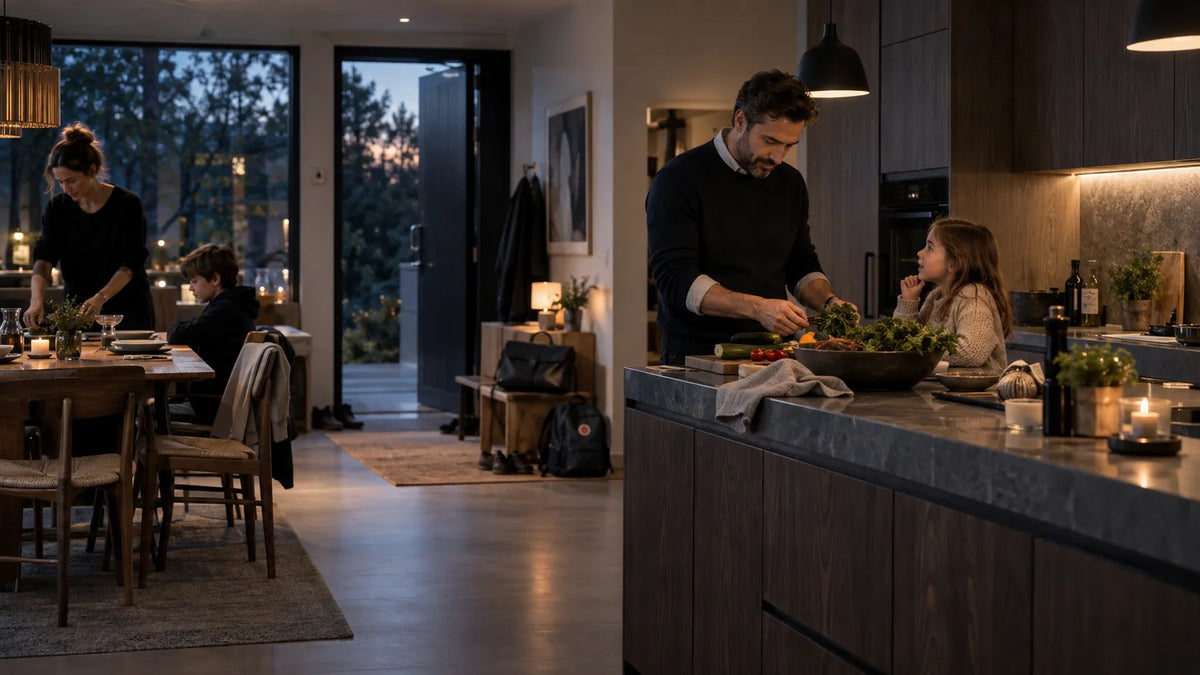
Your working day ends. But the day doesn't. You leave one set of responsibilities and walk into another. Dinner. Children. Bath. Bedtime. Laundry. School things. Tidying. Tomorrow. A conversation with your partner.
Someone remembers something that needs doing. Someone can't find something. Someone is upset. By the time the house becomes quieter, you may feel like:
I've just finished my second shift.
That language can feel uncomfortable. You love your family. You chose fatherhood. You don't want your children to feel like work. And yet the experience can still be real:
one demanding part of the day ends and another demanding part begins.
Recognising that does not mean your family is a burden. It means family life contains real work too.
Family life contains work — even when it is deeply meaningful
Love doesn't remove effort. Neither does meaning. You can love carrying your sleeping child upstairs and still find them heavy. You can care deeply about bedtime and still be tired of negotiating it. You can value sharing dinner and still not want to decide what everyone is eating.
Family life contains:
physical work;
planning;
decision-making;
remembering;
organising;
emotional attention;
care;
and constant adaptation.
Researchers increasingly distinguish between visible household tasks and cognitive labour: the noticing, anticipating, planning and coordinating required to keep family life functioning. (DOI)
That is important because:
Not all family work looks like doing something. Sometimes the work is remembering that something needs doing at all.
1. The second shift feeling often comes from accumulation
Imagine each part of your day separately. A demanding meeting? Manageable. Cooking dinner? Manageable. A child who refuses bedtime? Manageable. Laundry? Manageable. Tomorrow's school requirement? Manageable. Your partner needing to discuss something? Manageable.
But place all of them after an already demanding working day. Now the issue may not be any one task.
It is:
the sequence.
Work-family research describes conflict when demands from one role interfere with participation in another, and recent systematic review evidence emphasises that this is not simply an individual time-management problem; workplace structures, family demands and broader contextual factors all contribute. (ScienceDirect)
Sometimes you don't need a better attitude towards the final task. You need to understand everything that came before it.
2. Paid work ending doesn't mean responsibility ends
One reason evenings can feel intense is that there may be almost no period where nobody needs something from you.
At work:
customers;
patients;
colleagues;
deadlines;
managers;
systems.
Then home:
children;
partner;
household;
tomorrow.
The type of responsibility changes. The fact of responsibility does not. That can create a particular kind of fatigue:
I don't necessarily want to do nothing. I just want nobody to need anything from me for a minute.
That feeling does not automatically mean you're withdrawing from family life. It may mean you've spent much of the day responding. The useful question is:
Where, if anywhere, does responsibility temporarily reduce?
For some fathers, the answer may be:
Almost nowhere. That deserves attention.
3. The evening has its own peak hours
Family demands aren't evenly distributed throughout the day. They often cluster. Late afternoon. Dinner. Bath. Bedtime. Tomorrow's preparation. Exactly when the working day has already consumed part of your time and energy. This can produce a strange mismatch. At 11:00 you may have had far more capacity. At 18:30 you have more family demand. That doesn't mean your children are asking too much.
It means:
demand and capacity can peak in opposite directions.
This is why the same bedtime behaviour may be perfectly manageable on Sunday and almost unbearable on Wednesday. The child didn't necessarily change. The day around the child did.
4. Household work doesn't become less real because nobody pays you for it
Laundry is still work. Cooking is work. Cleaning is work. Scheduling is work. Organising childcare is work. Planning meals is work. Making sure clothes still fit is work. Knowing the school calendar is work.
Recent research using survey data from 3,000 US parents found that cognitive household labour clusters into different kinds of tasks. Mothers reported carrying substantially more of the routine, day-to-day cognitive labour around areas such as cleaning, scheduling, childcare and food, while fathers more often reported responsibility for episodic tasks such as maintenance and finances. (DOI)
That matters here for two reasons.
First:
family work includes more than the task you can currently see.
Second:
don't assume that because you feel heavily loaded, everyone else around you is carrying less.
Your partner may be experiencing their own second shift — and may have started parts of it long before you arrived home.
5. “I worked all day” can hide what happened elsewhere
This sentence causes arguments:
I've been at work all day.
Sometimes what is meant is:
I'm exhausted and I need you to see that.
But the sentence can be heard as:
What I've done counts more than what you've done.
Especially if your partner has spent the day:
working;
caring for children;
managing appointments;
cleaning;
shopping;
planning;
or moving between several of those.
Paid work is visible. It has working hours. Job titles. Meetings. Outputs. Domestic work often has less obvious edges. A more useful sentence might be:
I've had a demanding day. How are you doing?
Now both realities can exist. Fatherhood is relational. Your tiredness matters. It doesn't have to invalidate someone else's.
6. The mental load may continue even when you sit down
Dinner finished. Kitchen mostly done. Child in bed. You sit. But your head contains:
school bag;
milk;
tomorrow's meeting;
car service;
birthday present;
the bill;
childcare next Thursday;
something your partner asked you not to forget.
This is where cognitive household labour matters.
Recent father-specific qualitative research found that fathers themselves described significant mental load around being actively and emotionally engaged fathers and thinking about their children's longer-term development. At the same time, the researchers found persistent gender differences in how domestic cognitive labour was understood and divided. (Taylor & Francis Online)
In other words:
modern fatherhood can contain more thinking about fatherhood than previous fathering norms expected.
That's meaningful progress. It is also still labour.
7. But be careful with the conclusion: “We both do the same”
This is worth making explicit. A father can genuinely feel heavily involved. And genuinely carry a lot. And the division can still be unequal. Those statements can coexist.
The 2025 study of 3,000 US parents found a pronounced gender pattern in cognitive labour: mothers carried more routine daily household thinking, while fathers reported more responsibility for episodic maintenance and finance tasks. Fathers were also more likely than mothers to describe some responsibilities as equally shared. (DOI)
That doesn't tell us what happens in your household. It does tell us:
your own sense of how much you are carrying is not enough to determine how the total load is divided.
Neither is your partner's alone. Sometimes you need to make the work visible first.
8. Don't count tasks. Look at ownership.
Imagine:
You cook dinner.
Your partner:
noticed there was no food;
decided what meals were needed;
checked who was home;
made the shopping list;
ordered groceries;
remembered your child's dietary issue;
and asked you to cook.
Who did dinner?
You did.
Who owned dinner?
More complicated.
This is the distinction between helping and ownership. Helping asks:
What do you need me to do?
Ownership asks:
What needs doing, and am I responsible for seeing it through?
This will be explored properly later in:
What Does Taking Ownership at Home Actually Mean?
For now, notice that a family can divide visible tasks fairly while one person still carries much more of the noticing and coordination.
9. Ownership can also reduce your own sense of being constantly assigned tasks
There is another side to this. If your partner is the household manager and you mainly receive:
Can you do this?
Don't forget that.
Can you take them there?
you may feel like the evening is an endless list of incoming demands. That experience is real.
But the solution may not be:
Give me fewer tasks.
It may sometimes be:
Own an area so somebody doesn't have to keep turning it into tasks for you.
For example:
not:
Tell me when the children need new shoes.
but:
I own their shoes. I notice, choose, buy and replace them.
Not every family needs this exact division. The principle is:
responsibility can sometimes feel lighter when it becomes clear rather than constantly arriving as interruption.
And it can reduce someone else's mental load at the same time.
10. Don't turn home into another productivity system
There is an obvious danger. You recognise household work. So you create:
systems;
boards;
apps;
weekly stand-ups;
KPIs for laundry.
No.
Some structure can help. But your home doesn't need to become the operations department of your second shift. The purpose of organising family work is:
to make life easier to live. Not to make every part of life measurable.
BRTLS Principle:
Development should serve life.
If the system requires more maintenance than the problem it solves, it probably isn't helping.
11. Sometimes the problem is simply too much work
Not every difficult evening contains a communication lesson. Maybe:
you work ten hours;
your partner works eight;
there are two young children;
no family nearby;
childcare ends early;
the house requires maintenance;
both of you are sleeping badly.
There may simply be too much total demand.
Recent work-family-conflict literature increasingly treats the issue as systemic as well as individual, pointing to factors such as inflexible jobs and inadequate childcare rather than framing conflict purely as a resilience deficit. (ScienceDirect)
That matters. Because otherwise the solution becomes:
divide an impossible workload more efficiently. Sometimes the workload itself needs questioning. Can something stop? Be postponed? Bought? Shared? Outsourced if affordable? Done less often? Simplified? Or accepted as imperfect? The answer isn't always “try harder together.”
12. Household standards create demand too
Floors. Laundry. Cooking. Tidiness. Activities. Birthday parties. Fresh meals. Garden. DIY. Social obligations. Children's activities. Some are necessary. Some matter deeply to your family. Some may simply be the standard you have inherited.
Worth asking:
Who decided this has to happen this often, this well, or at all?
Maybe the answer is:
We genuinely care about it. Fine.
Maybe:
Nobody. We just do it. Then there may be room. Lowering one household standard for a demanding period is not necessarily giving up. It can be demand management.
13. Children also create unpredictable work
You planned a simple bedtime. Your child is suddenly worried about school. Now bedtime takes forty minutes longer. The obvious household plan says:
Story. Teeth. Bed.
The actual fatherhood moment says:
Something matters here.
This is why family life resists perfect efficiency. People are not tasks. Sometimes what makes the “second shift” hard is exactly what makes family life meaningful:
someone needs more than the schedule anticipated.
That doesn't make the extra demand effortless. It means:
not every inefficiency is a problem to remove.
Some are the relationship.
14. Ask whether both adults have an end to the day
This can be revealing. Maybe you finish work at 17:30. Your partner finishes paid work at 17:00. Then family work continues. At 20:00, you sit down. Your partner:
packs tomorrow's bag;
orders something for school;
messages childcare;
plans Friday;
folds laundry.
Has their shift ended? Maybe not. Or reverse the roles. The useful question is not:
Who works hardest?
It is:
Where does each person's responsibility actually stop?
If one person's leisure reliably begins while the other's invisible work continues, that pattern deserves discussion.
15. Recovery needs to exist somewhere
If paid work flows into household work, which flows into bedtime, which flows into life admin, recovery can become:
whatever is left after everything else.
Sometimes that is twenty minutes. Sometimes nothing. That is difficult to sustain indefinitely. But recovery doesn't necessarily mean both people need two hours of uninterrupted leisure every evening. The more realistic question is: Does each person have enough opportunity to come down from responsibility somewhere across the day or week?
That may look different for each of you. And some stages of family life will offer much less than others. Again:
agency within constraints.
16. Make the invisible part visible before arguing about fairness
Instead of starting with:
You don't do enough.
or:
I do loads.
Try mapping one ordinary week. Not to score points.
Look at categories:
children
food
cleaning
laundry
planning
appointments
finances
maintenance
school or childcare
social/family obligations
transport
Then ask:
Who notices it?
Who plans it?
Who does it?
Who checks whether it happened?
You may find the load is fairer than either of you thought. Or less fair. Both outcomes are useful information.
TRY THIS
The evening workload check
Choose one ordinary weekday. Don't change anything yet.
1 — WHEN DOES PAID WORK ACTUALLY END?
Not just when you leave. When are you no longer responding to it?
2 — WHAT HAPPENS FROM THEN UNTIL THE HOUSE SETTLES?
Write down the real sequence. Pick-up. Dinner. Children. Cleaning. Bedtime. Planning. Everything.
3 — WHO OWNS WHAT?
Not only who physically does it. Who:
notices;
remembers;
plans;
executes;
follows up?
4 — WHERE IS THE HARDEST 30 MINUTES?
This matters more than counting every task. Maybe 17:30–18:00 is the collision point.
5 — WHAT COULD MAKE THAT WINDOW 10% EASIER?
Not perfect. Ten percent. Earlier food? Clearer ownership? Simpler dinner? One parent doing bedtime while the other resets? Work ending ten minutes earlier? Preparing something the night before? Lowering a standard? Then try it. See what happens.
What if my partner says they carry much more than I realise?
Resist the urge to answer immediately with your list. Listen first.
Ask:
What am I not seeing?
Maybe there are things you genuinely don't know happen. That is precisely why cognitive labour can be invisible. Then share your own experience too.
This doesn't require deciding:
Who has it worse? It requires building a more accurate picture.
Research currently suggests that routine cognitive household labour remains disproportionately carried by mothers in many heterosexual couples. (DOI)
That doesn't determine your family. But it is a good reason not to assume the division is equal simply because both people are busy.
What if I really am carrying most of it?
That happens too. You may be:
a single father;
the primary carer;
the parent with greater availability;
the person who manages most household life;
or simply living in a relationship where the division is currently unequal in the other direction.
Then the same principle applies. Make the load visible. What can another person own? What can disappear? What needs discussion? What cannot change?
BRTLS is not interested in assigning domestic responsibility based on gender. It is interested in understanding the actual life being lived.
YOUR FAMILY ISN'T A SECOND JOB
This matters enough to say clearly. Family isn't another employment contract. Your child isn't a task. Your partner isn't your colleague. Home isn't your second workplace. But family life does contain work. Sometimes a lot of it. And pretending that meaningful things shouldn't require effort can make ordinary strain feel like evidence that something is wrong with you. You can love fatherhood and still feel exhausted by the evening. You can value your home and still not want to clean it. You can want to be involved and still wish nobody needed anything for ten minutes. Those things can coexist.
The more useful question isn't:
Why does my family feel like work?
It may be:
How much total demand are we carrying — how is it divided — and is the current way of doing this still workable?
That question includes you. And everyone else living the evening with you.
EXPLORE THE WIDER PICTURE
Work-Life Balance for Fathers: A Better Question Than Balance
If the bigger issue is how your working life fits family life as a whole:
→ Read: Work-Life Balance for Fathers
Why Do I Have Nothing Left for My Family After Work?
If the main issue is that you repeatedly arrive home depleted:
→ Read: Why Do I Have Nothing Left for My Family After Work?
How Do I Balance Work and Being a Dad?
If you want a practical way to make the coming week more workable:
→ Read: How Do I Balance Work and Being a Dad?
Home
What kind of home am I helping create?
Partner
What kind of relationship are we building?
Health & Vitality
Do I have the capacity to show up?