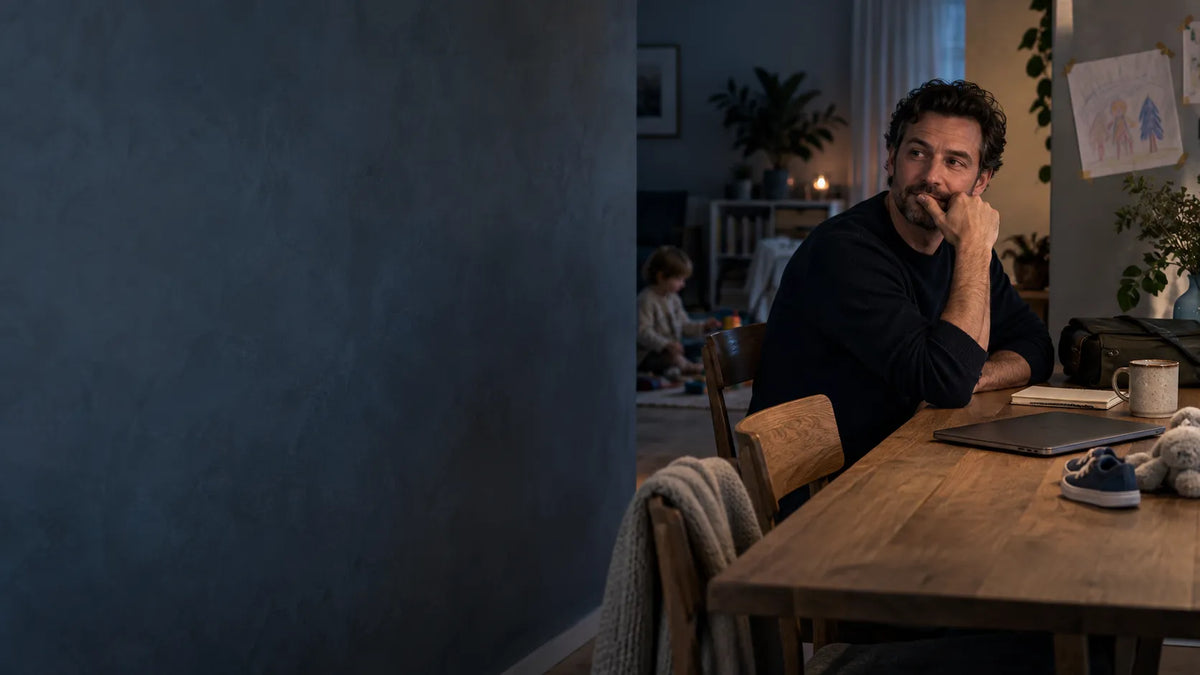

You managed all day. Meetings. Questions. Deadlines. Traffic. Problems. People needing things from you. You kept yourself together. Then you come home.
Your child refuses dinner. Someone spills a drink. Shoes are left in the hallway. Bedtime takes longer than expected. And suddenly you hear yourself respond far more sharply than the situation deserved.
Later, you wonder:
Why do I have so little patience with the people I care about most?
It can feel particularly uncomfortable because you managed to stay patient at work. You were professional with colleagues. Calm with clients. Reasonable when things went wrong. Then your family gets the shortest version of you.
Sometimes patience disappears at home not because your family matters less, but because they meet you after much of the day's capacity has already been used.
That does not remove responsibility for how you respond. But it can help you understand where to look.
Patience is not an unlimited personality trait
We often talk about patience as though some people simply have it and others do not. But your ability to tolerate interruption, noise, delay and frustration changes.
Sleep affects it. Stress affects it. Hunger affects it. Cognitive load affects it. The number of decisions you have already made affects it. So does the amount of emotional regulation your day required.
That means the same father can respond very differently to the same behaviour at 08:00 and 18:30. The child did not necessarily change. The available capacity did.
Work may require more regulation than you notice
Many jobs require you to manage yourself constantly. You cannot tell a difficult colleague exactly what you think. You remain polite with an unreasonable customer. You concentrate when you would rather stop. You sit through another meeting. You make decisions. You switch between tasks. You respond to messages. You manage uncertainty. You maintain a professional tone.
None of those things need to feel dramatic individually. Together, they can create a substantial demand. By the time you arrive home, the system that helped you remain composed all day may have less flexibility left.
Home often asks for exactly what work has depleted
This is part of what makes the transition difficult. Young children require patience.
They repeat themselves. Move slowly. Change their minds. Interrupt. Need help with things they did independently yesterday. Become emotional about situations that appear insignificant to an adult.
Family life also contains noise, competing demands and unpredictability. So the part of you that has already spent the day adapting may enter an environment that asks for even more adaptation.
That can create friction quickly.
The final small thing can receive the whole day's reaction
Imagine your working day was difficult.
You slept badly. A meeting ran over. You skipped lunch. Traffic was slow. You arrive home later than intended. Then your child knocks over a glass of milk. The milk is a small problem. But your reaction may contain far more than milk. It contains the meeting. The hunger. The traffic. The hurry. The unfinished work. The fact that you are already behind on the evening you imagined.
Understanding that does not make shouting acceptable. It does something more useful. It shows you that preventing the next reaction may require looking further back than the glass.
Responsibility and context can exist together
There are two unhelpful extremes here. One is:
I'm stressed, so I can't help how I react.
The other is:
If I were a better father, none of these circumstances would affect me.
Neither is particularly useful. You remain responsible for how you treat the people around you. And your behaviour occurs within conditions that make some responses more or less likely.
Understanding those conditions gives you more options. You can repair after reacting badly. And you can investigate what repeatedly brings you to the edge in the first place.
Look at when your patience disappears
Rather than deciding:
I need to become more patient
look for the pattern.
Is it immediately after work? During dinner? At bedtime? On days you commute? After certain kinds of meetings? When you have not eaten? When you work from home and move directly from your final call into family life? When both children need you simultaneously? When the evening feels behind schedule?
Patterns turn a character judgement into information. And information is easier to work with.
Sometimes the problem begins before work
It is also possible to blame work too quickly.
Perhaps you are chronically underslept. Perhaps there is almost no recovery anywhere in the week. Perhaps mornings are already chaotic. Perhaps you are carrying financial pressure. Perhaps the household workload feels unresolved. Perhaps you have been trying to operate at maximum capacity for months.
Work may be where much of the load occurs. It may not be the only source. This is why a wider view matters. The difficulty may sit across Work, Health & Vitality, Home, Partner and Self rather than neatly inside one category.
The transition can matter
If you go directly from high-demand work into high-demand family life, there may be almost no opportunity to change pace.
For some fathers, a commute creates a natural boundary. For others, the commute itself adds stress.
Working from home can make the transition even shorter. Laptop closed. Door opens. Dad. There is no universal amount of decompression you need. But it can be useful to ask whether a small transition would help. A short walk. Changing clothes. Eating something. Three quiet minutes in the car. Putting the phone away. Not because these are magic rituals. Because they can interrupt the automatic continuation of the working day.
Any transition also has to fit the household. Forty-five minutes alone may help you recover while leaving your partner to carry the hardest part of the evening. The solution should not simply move the pressure to someone else.
Lowering unnecessary demands can create patience too
Sometimes we try to improve patience entirely from inside ourselves. Breathe more. Stay calm. Try harder. But perhaps the evening itself is asking too much.
Does dinner need to be elaborate? Does everything need cleaning tonight? Does bedtime need to happen at exactly the planned minute? Can one commitment disappear? Can something be prepared earlier? Can expectations change on particularly demanding workdays?
Development does not only happen by increasing your ability to handle more. Sometimes it happens by removing demands that do not need to be there.
Repair matters
Even with better understanding, you will sometimes respond in ways you regret. Fatherhood does not require flawless regulation.
When you react too sharply, repair can be simple. Acknowledge what happened. Take responsibility. Reconnect. You do not need to make your child responsible for your stress. You can say that you were frustrated and responded too strongly.
Understanding your context is useful for changing the pattern. It is not something your family needs to carry for you.
Your evening may be giving you information about your day
If you consistently have almost no patience left when work ends, do not only treat the evening as the problem. The evening may be showing you the accumulated effect of everything that happened before it. That could mean your transition needs attention. Your workload. Your sleep. Your food. Your expectations. Your recovery. Your household organisation. Or several of them together.
You do not need to know the answer immediately. Start by noticing the pattern.
A question to take with you
The next time you notice your patience disappearing, ask:
What has already been asked of me before this moment?
Not to excuse the reaction. To understand it. Because sometimes becoming more patient at 18:30 starts with looking at what happened at 10:00, 14:00 or 17:45.