
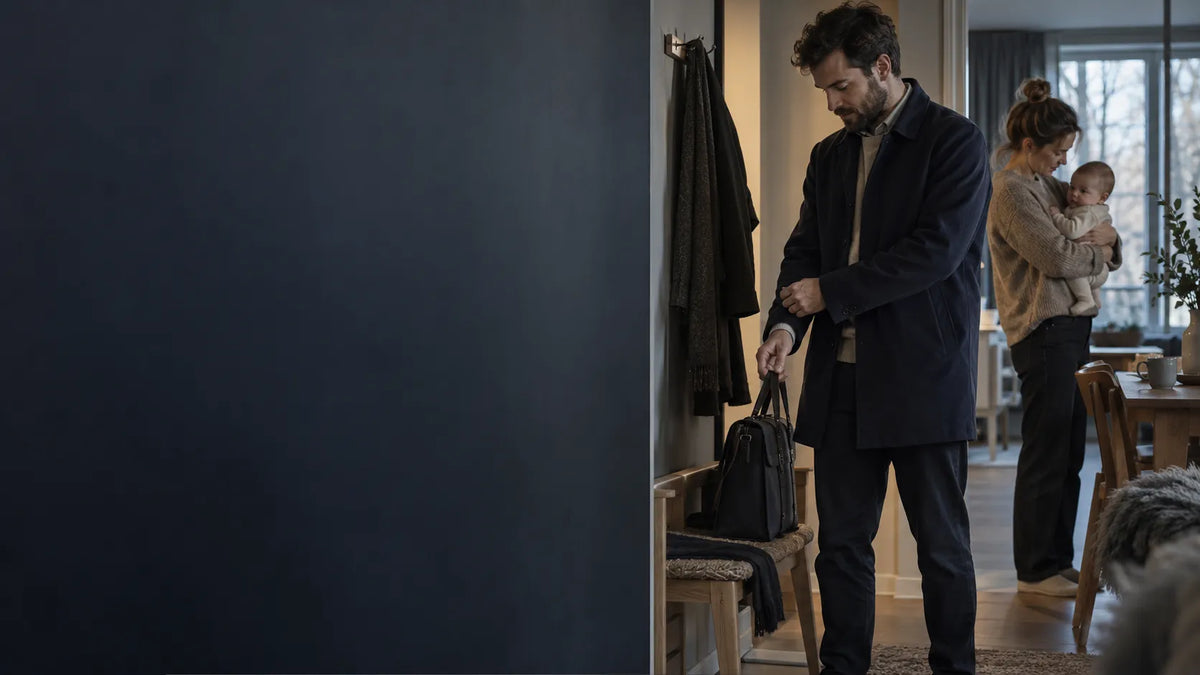
Your inbox is still there. The meetings return. People ask how the baby is. Someone makes a joke about sleep. And within a few hours, parts of working life can look remarkably similar to how you left them. But you are returning to work after something significant changed.
There is now a child at home. Your partner may be there too. Sleep may be completely different. Your responsibilities are different. The way you think about time may have changed. And work may no longer occupy exactly the same place in your life.
Returning to work after paternity leave is not only a return to your job. It can be part of the transition into being both a father and the working person you were before.
Work may look the same while you feel different
This can be disorienting. Your colleagues continued working. Projects moved forward. The organisation kept going. Then you return. Your chair is still there. The software looks the same. The problems are familiar. But your life outside work has changed dramatically.
That difference can make returning feel stranger than expected. You may be happy to use your professional brain again. You may miss your baby. You may feel relieved to leave the house. Then guilty for feeling relieved. Several reactions can exist at once.
You do not need to choose between enjoying work and missing home
You may have imagined that returning would feel terrible. Instead, part of you enjoys it.
Adult conversation. Competence. Structure. Finishing something. Coffee while it is still hot.
That does not mean you wanted to escape fatherhood. Likewise, finding work difficult does not mean you have lost your ambition. Your identity has expanded. Work is now interacting with something that did not exist in the same way before.
Give that relationship time to develop.
Sleep changes what work feels like
The job may be familiar. Doing it after broken sleep may not be. Concentration can be harder. Your patience may be different. Simple decisions can feel surprisingly demanding.
Then you come home and another part of the day begins. It is easy to interpret this as:
I'm not coping.
A more useful interpretation may be:
The same workload is now happening under different conditions.
That matters. Especially in the early months.
The first days back can create guilt in both directions
At work:
I should be at home.
At home:
I need to perform properly at work.
Your partner may have had a difficult day. You have deadlines. The baby does not care about either schedule. You may feel as though you are disappointing someone regardless of what you choose. That does not necessarily mean there is a correct choice you are failing to find.
Sometimes two responsibilities genuinely compete. The task is learning how you want to navigate them.
Your partner's return-to-work experience may be different from yours
Depending on your leave arrangements, you may return while your partner remains home. That can create two very different days. You return to colleagues, structure and professional identity. Your partner may remain inside the intensity of caring for a young baby.
Neither experience needs to be ranked as harder. But they need to be understood. Arriving home exhausted from work does not mean the person at home has been waiting in a state of rest. The handover between those two days deserves attention.
Do not assume the old work pattern still fits
Before becoming a father, staying thirty minutes late may have barely registered. Now those thirty minutes can affect dinner, childcare, your partner's evening or the short period you have with your baby before sleep.
Travel may feel different. Early meetings may matter differently. Evenings may no longer be an easy place to finish unfinished work. You do not have to change everything. But it is worth noticing which old habits now have a different cost.
Your ambition may change — or it may not
Some fathers return to work with less interest in career progression. Others feel more motivated. Providing matters more. Security matters more. They want to build something. Some feel both.
Do not rush to define what fatherhood has done to your ambition. A few exhausted weeks with a newborn are not necessarily evidence about the next twenty years of your career. Let experience accumulate.
Your relationship with work can change without requiring an immediate career decision.
Ask what flexibility actually matters
Generic flexibility sounds useful. Specific flexibility is more useful.
Starting thirty minutes later?
Working from home one day?
Being able to leave when childcare fails?
Protecting a particular evening?
Moving a recurring meeting?
Having predictable hours?
You may not have control over all of these. But identifying what would materially improve the week makes it easier to have a concrete conversation at work.
You may need new boundaries
Before children, work could expand into the evening because little stopped it. Now there is something else on the other side. That can make boundaries feel more urgent.Not every message needs an immediate response.
Not every unfinished task needs to come home. Not every opportunity needs to be accepted. The aim is not to become less committed to work. It is to decide what commitment looks like in the life you have now.
Give yourself time to gather information
Returning to work can create strong conclusions.
I can't do this anymore.
I need another job.
I don't care about my career.
I need to work harder now that I have a family.
Maybe one of those conclusions will remain true. But the early return period contains unusual conditions.
Sleep deprivation. New logistics. New responsibilities. A relationship adjusting. A baby changing rapidly. Observe before you make every feeling permanent.
What becomes easier?
What remains difficult?
What repeatedly causes friction?
What unexpectedly works well?
Experience gives you information.
Fatherhood does not replace your working identity
You were a person before becoming a father. You may have spent years developing skills, relationships, ambitions and a professional identity.
Those things do not disappear. At the same time, work no longer exists in exactly the same life. The goal does not have to be choosing which identity wins. It can be learning how they now coexist.
That may take longer than your paternity leave.
A question to take with you
As you return, do not only ask:
How do I get back to normal at work?
Ask:
What does work need to look like now that the life around it has changed?
Some parts may return exactly as they were. Others may need adjusting. You do not need to know which ones before you begin. The return itself will teach you something.